Showing posts with label Dungeons and Dragons. Show all posts

Monday, December 3, 2012

Twelve medicinal herbs for your campaign...


She's the one they call Doctor Feelgood...


Medicinal Plants & Herbs

Sometimes you need some good old-fashioned non-magical healing.  Plants have always been a source of medicine and our ancestors found a use for EVERY plant.  We've forgotten much of that old lore, but there's still a surprising amount of information that survived through the ages.  Google medicinal herbs and be prepared to have you mind blown.

It's not difficult to make your own fantastical plants and herbs, using real-world plants for inspiration.  Just decide what you want your plant to do and slap an exotic name on it.  In the meantime, here's a list of my own fantasy plants to give you something fun to do with that herbalism non-weapon proficiency.


1) Tuluni (Purgatus): This is a flowering vine with pale yellow or orange flowers. When the mature, woody portion is cut, a translucent amber fluid seeps from the vines .  This is a powerful natural laxative, but it does not travel well until it has been distilled into an oil by a skilled alchemist or herbalist. The purified oil is known as Purgatus, and a single drop is enough to get the most stubborn bowels moving.  The leaves can be boiled in a tea to produce a similar but weaker laxative.  Older folk sometimes use this tea to promote regularity.

2) Heshloi: This vine has small spear-shaped leaves and fluid-bearing nodules along the shaft.  The fluid inside is an emetic, used to induce vomiting.

3) Mugu: This shrub is mostly known for its bland, but edible berries and it's tiny blue flowers.  The leaves bear an anti-inflammatory agent that is often used to treat headaches and menstrual cramps, among other things.

4) Broadleaf (Wild Tea): A shrubbery, with large broad leaves and pink or white flowers.  It has caffeine and is often used to make tea.  Fresh leaves provide a stronger buzz but the flavor is inferior to dried leaves.

5) Goomuckle: This leafy vine bears a milky white sap when cut.  This sap relieves pain, induces sleep, and boosts the immune system (+2 to saving throws, +10% system shock vs disease).

6) Duliyec: This rare plant has long spear shaped leaves and a yellow flower with eight slender petals.  The leaves develop a hallucinogenic toxin when dried.  The leaves are then crushed and smoked, and used in dreamquests by the nomadic peoples of the Vardezzi grasslands.  These visions may or may not be helpful, but there's always a risk of insanity or burnout so the vision ceremony is never undertaken lightly.

7) Vejeldt: This thorny weed has a tangy, sour flavor to it.  The roots are nutritious (if bland) and the leaves are frequently added to salads to jazz things up and are a good source of vitamin C (prevents scurvy and is necessary for proper function of the immune system).

8) Whitestar: This is a slender tree with large white star-shaped flowers.  The berries have a beneficial effect on the immune system.  A small handful boosts the immune system against viral diseases (not fungal or bacterial diseases).  If taken before exposure to disease, it adds +3 to saving throws (+15% to system shock tests vs disease).  Once a virus has been contracted, it adds +1 to saving throws (+5% to system shock tests vs disease).

9) Friella: This small evergreen shrub contains a weak opiate. Crushed and ingested, it causes a sleepy state and a mild, happy buzz.  Offers good pain relief for minor aches and pains.

10) Strannus: This parasitic vine grows on tree trunks. The long thin leaves contain a powerful stimulant. It is usually chewed, but can be brewed as tea, or smoked. It can become addictive if used regularly.

11) Stirsey: This leafy shrub contains menthol, and the plant can often be smelt before it is seen.  It is used to treat coughs and as an aromatic herb.

12) Jahuul: Has a mild antibiotic effect.  As a tea, it can be drunk to cure many stomach ailments or boost the immune system.  To treat wounds, the leaves can be crushed and mixed into a poultice to keep a wound from getting infected. Adds +2 or 10% to to savings throws/system shock checks vs infection.  Check once per day.  If the save is successful, the bonus for the next check is 20%.  If that save is successful the patient will recover in d6 days as long as the treatment is continued.  If a save is failed, the bonus goes back down to normal.

NOTE: Antibiotics can only cure bacterial infections!  Viral or fungal infections cannot be treated with antibiotics.

I'm in yer gardin, eatin' yer herbs.

Sunday, November 25, 2012

Bards 2, The 2E Bard

                                              The rarely seen dual class nun-bard

The Second Edition AD&D Bard is my favorite class in the game.

Unlike the 1E bard, the 2E bard has rather lenient stat requirements.  You need a 15 CHA, 13 INT, and a 12 STR.  That's not unduly harsh (even for a straight 3d6 in order), and most DMs are more lenient than that.

As the description says, the bard is a Jack-of-all-trades and a master of none.  He fights decently, has a few thief skills, can cast a good selection of spells, and has his own unique bardic abilities. There's also a good selection of magical and mundane equipment that he can utilize. He's a character that can be useful in almost any situation.

While he isn't a tank, he is a fair combatant.  His THACO advances at half the rate of the warrior classes, which puts him near the middle of the pack, lagging just a bit behind the cleric.

The cleric has the advantage when it comes to taking damage, though.  He's got better hit dice (d8) and can wear any armor and use any shield.  The bard will usually lag behind in hit points and is limited to chain mail or less, and can't use a shield.

But the bard is capable of dishing out a lot more damage.  His ability to use any weapon means that he can use the best weapon for the situation, and he can use heavier weapons that do more damage.  His ability to use a bow allows him to provide much better fire-support than the cleric (who is limited to slings).

Even better, the bard can take advantage of some of the really awesome optional proficiencies listed in the Complete Fighter's Handbook.  In particular, two-weapon specialization gives the bard the ability to dual-wield like a ranger, which doubles his combat attacks.  The cleric can't do this (he gets an inferior weapon/shield combo instead).

The bard's thief abilities aren't amazing, but they are useful and flavorful.  He can pick pockets, hear noise, climb walls, and read languages.  Climb walls, in particular, is a very useful skill in a game based on exploration, and hear noise and read languages aren't bad, either.  Picking pockets may or may not be useful depending on the DM, but that's a whole different issue...

The bard's best (and most powerful ability) is the ability to use magic-user spells.  Magic is incredibly powerful in AD&D and spellcasting classes have a huge advantage over those classes who cannot cast spells. While the bard cannot access magic spells of 7th level or higher, I would argue that he is the second best spellcaster in the Player's Handbook (behind the mage/specialist wizard).

Sure, the cleric has more spells (some very powerful), but clerical magic is much more restrictive, and it lacks the utility and damage spells that make the magic user list so amazing and versatile.  The clerical spell list has nothing like a fireball or a lightning bolt, or even something as simple and versatile as Grease.

And while the bard may have less spells and a slower learning rate than a typical wizard, he casts spells at the same power as a wizard once he learns them.  A 7th level wizard and a 7th level bard both cast Fireball spells with 7 hit dice.

The bard also has some unique class abilities of his own.  He can shift reaction rolls, buff his allies, counter music/sound based attacks, and he's got a special Legend Lore ability that allows him to know about obscure things in the game.

Legend Lore is an under-appreciated ability, but it can be extremely useful if used correctly.  Information is power, and the bard has a built-in ability to know a little bit about almost everything.

The bard's high natural charisma and ability to shift reaction rolls make him a great diplomat (or instigator), and a good party leader.  If you want to loosen up the tongues of a tavernful of townsfolk, there's nobody better than the bard for this task.  Put on an entertaining show, sing a few classic drinking songs, and you'll be pulling in rumors in no time.

He's also a good bet for scamming or weaselling his way into places where he can cause mischief.  Sure, the paladin might have higher charisma, but he's much too scrupulous to take advantage of anybody.  The bard, on the other hand, is naturally a bit of a rascal.

And speaking of bards and paladins, I've got a little story for you...

Back in an old high school game, I played the bard in our group, along with a paladin named Kylinar, and a couple of other characters.  We were all 2nd level or so, and we were doing a dungeon crawl when we came across a skull sitting on the floor, with gemstones in the eye sockets.

Knowing damned well that the DM was an asshole, I yelled out "Don't touch it, it's a demilich!"

So Kylinar, the paladin, walked over to the skull to poke at it with his sword.  And just as I'd suspected, the skull flew up and started screaming, and it killed everybody in the room... except for Kylinar.

Needless to say, we were all pissed off.  The DM was generous though, and he allowed the paladin to raise our characters from the dead, even though this is normally not possible if you die in this manner.  I guess the DM was feeling guilty for putting us up against something so nasty, so he gave us a little wiggle room to come back.

The first thing my bard did when he woke up was to compose a new song called "Kylinar the Klutz".  The DM thought it was hysterical (as did the rest of us who were slain), and the guy playing the paladin learned a valuable lesson when the song proved to be popular and it kept popping up in taverns wherever we went. It took him a long time to live that down.

Which brings me to the best part of the bard class, and the one thing that keeps me coming back to it again and again.

The bard is FUN.

The druid may be out of his element when he's in  dungeon.  The wizard may be useless once he's out of spells.  The fighter may be standing around, picking his nose, when there's no fighting to be done.  But there's always something useful to do when you play a bard.

As the "Swiss Army Knife" of character classes, the bard gets to be in the middle of everything. And quite often he gets to dominate the game, particularly in role playing situations where he shines.  The fact that he's not the "best caster" or the "best fighter" de-emphasizes the tendecy to power-game, and encourages the player to be creative and wily.  And the fact that he's an singing, dancing, juggling, attention whore brings out the role-playing element of the game out like no other character class.

I can honestly say that playing a bard has helped make me a better DM.  It's helped me loosen up, and take more risks as a role player, and has allowed me to really dig in to the personalities of the characters I play.

I don't get a chance to play very often anymore (I usually DM because it's hard to find  anybody else playing AD&D), but whenever I do, it's the bard that I gravitate toward.  Did I mention that the 2E bard fits nicely into 1E?


Wednesday, November 14, 2012

Some maps I made a few years ago...

Last month I wrote a blog entry that talked about a large cache of my old DM notes that I discovered while going through my storage unit.  I'd thought a lot of this tuff was lost forever so I was quite pleased to find not just my notes, but also a bunch of maps that I'd drawn over the years.

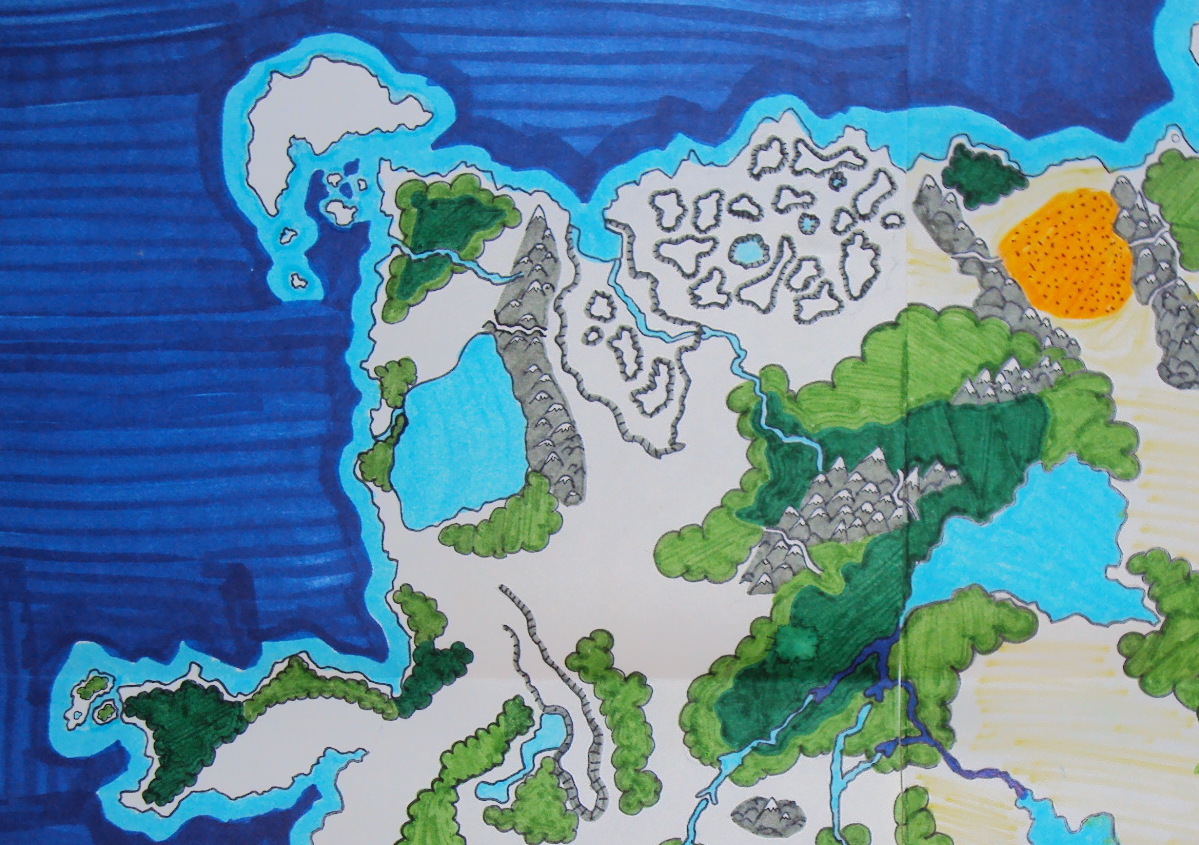
This particular map was one that I'd gone to a lot of effort to create, inspired by those lovely maps for the Greyhawk and Forgotten Realms settings.  This map is intended to represent a huge peninsula attached to a much larger continent (if you look near the upper right corner you can see where the map continues off the page).  

Click to expand maps

This map is not quite finished, I left a few areas blank so that I could fill them in later once I'd decided what I wanted to go there.  There's large blank chunk of land in the lower right corner that represents a part of the main continent, and something that could be a large island or peninsula.  There's also a small blank island in the upper right quadrant.  More on that later...

The map was sketched out on a large sheet of heavy paper with a pencil.  I went back over the pencil lines with a fine Rapidiograph technical pen.  The colored areas were done with marker pens (hence the stripey look).

The areas in light green represent light forest, the areas in dark green are heavy forest.  Light blue represents shallow water, and dark blue represents deeper waters (some river areas are also very deep).  The orangey areas are desert, and the grey areas are mountains (some of which have snow).  There are also some light green hills drawn in over the grassy areas, representing rolling hills.


This section of the map shows the upper left quadrant in greater detail.  The upper center section has an area of canyons and badlands (the area with the elevation lines).  The lower right section shows the large forested mountain area in the center of the continent, and the large sea that it wraps around.  There is another large sea or lake near the west coast, and below that is a forested peninsula.


This shows the lower left quadrant of the map.  There's a large forest to the south, with a river delta that flows through the woods and empties into the southern coast.  There's a ring of mountains with a blank center (not sure what I was going to put inside it) near the center of this map.  There's also an improbably desert surrounded by forest areas.  Oops!


Here's the lower right quadrant.  There's a volcano near the top/center of the map (note the smoke coming out of it), and a forest with a marshy coastline on the east coast of this landmass.  Toward the west, the two large inland seas are visible.  The white areas were left blank to be filled in later, but are supposed to be connected to the main continent that this peninsula is attached to.

This is the lower right quadrant, and you can see where it connects to the larger continent in northeast.  Most of the interesting features have already been mentioned, but there is a small mountain pass drawn through the mountain range in the center of the map.  I think that was originally supposed to be a dwarven outpost where they offloaded stuff from the bay and routed it through the pass.

A lot of work went into this map.  While I'm not terribly happy with it, I do think that it looks great.  This was intended to be a player map, something that they could touch and see, to help them visualize the game world.  I planned to use the transparent hex overlays that came in the TSR boxed sets to measure distances, but this map never ended up being used, and was stored away for almost 20 years.

If you want to try a map like this, make sure you have a lot of markers because it takes a lot of ink to fill in those large areas.

:)

Sunday, November 11, 2012

Bards- part 1

                                               
                                                   How to find wandering monsters.


Bards have been a part of the D&D universe for a long time.  Originally appearing in the 1st edition of AD&D, they have been a part of the game ever since.  In each version of the game, the bard has been radically different, changing more across each edition than any other class.

The first edition bard is one of the strangest, most convoluted classes the game has ever had.

It's also the hardest class to qualify for, requiring a 15 in Str, Dex, Wis, Cha, a 12 INT, and a 10 CON.  I looked up the odds for rolling that on a strict 3d6 (in order), and somebody figured out that 20 characters in one million would qualify.  Of course, you've also got to factor in the chance of character death on the way to becoming a bard, and since he's got to get to 5th level in fighter and thief classes first, that's a distinct possibility.

Now, it's true that the 1E game strongly advised against the 3d6 method that had been the standard up to this point.  The PHB flat-out states that a character should have at least two 15+ scores to ensure his survival.  Even stranger, the PHB does not tell the player how to roll his ability scores at all, instead telling the player to ask the DM (who will consult the DMG) who will presumably select a method that offers higher than average scores.

Now, given some of the extremely generous character generation methods proposed in the DMG, this made it much more likely that you'd get a special character class.  but even then the bard could be hard to get.  Method 1, probably the most popular option, only got you a bard about 1.5 percent of the time (to put that into perspective, Method 1 can generate paladins about 24% of the time) .

Unfortunately, a lot of DMs stuck with the old 3d6 (in order) enshrined in OD&D and the Holmes D&D set, which made it virtually impossible to get a bard.  It didn't help that the PHB and DMG were released a year apart, and that no character generation methods were presented in the PHB.

No wonder the 1E bard languished in obscurity.

Which is kind of sad, because it's actually a pretty interesting class.  It starts with 5-7 levels as a fighter, followed by 5-8 levels as a thief.  After that, they can start training as a bard, using the special advancement table provided.

While that might seem like a tall order, it actually takes less XP to get to 5th level as a fighter, thief, and bard than it does to get to 7th level as a single-classed fighter.

Unfortunately, the bard's fighter class doesn't really contribute much to the his skills, since the fighter doesn't really have any class-based skills of his own.  Only his d10 hit dice and THACO are retained, and the bard's THACO never improves afterward.  At low levels, this means that the bard is pretty badass compared to clerics, thieves, and magic users, but all of them will eventually overtake him.

A bard with maxed-out fighter levels (level 7) will be equal to or worse than level 10 clerics, and level 13 thieves and assassins.  Sadly, by level 16, wizards will actually hit more often than the bard does.  If he didn't max out his warrior levels he'll be even worse (and he'll have less potential HP too).

The thief's skills all carry over to the bard, however.  Effectively, this leaves the bard with all of the percentage-based skills, thieves cant, and backstab.

The bard's class abilities are based on a modified version of the druid (with weaker spellcasting), and the bard's own unique abilities.  He still gets all of the druid's goodies (including the ability to shapechange into animals), but he doesn't have to fight druids to advance, since he's technically a bard, not a druid.

The end result is a mediocre combatant with good hit points, with thief skills, druid skills, limited druid magic, and special bard abilities.  This is a very versatile character, but it's really not overpowered, since he's not allowed to use any of the higher level capabilities of his component classes.

Nonetheless, I think this is a good example of the worst excesses of the first edition.  It's unnecessarily complex (I'd hate to see that character sheet), hard to qualify for, and the individual parts really don't go very well together (fighter/thief/druid/bard?).  The whole thing feels rough and experimental, like a beta version that was never supposed to be released to the general public.

There's also this:  The PHB states that the bard must always have stringed instrument.  Fair enough.  But it never tells us why that is, or what would happen if his stringed instrument is lost or destroyed and he cannot find a replacement.  Given the delicate nature of stringed instruments, and the rigors of adventuring, it's bound to come up sooner or later.


Given the wonkiness of the 1E bard, it's no surprise that they were rarely used.  Sadly, it wasn't until the 2nd edition of AD&D that the bard really hit its stride.

Friday, November 2, 2012

Ravenloft...

Yeah, I know it's slightly after Halloween, but I'm still in the mood for spooky things so I'm gonna post about AD&Ds classic horror setting anyway.


The original Ravenloft module was one of the first modules that I had as a DM.  A buddy of mine had loaned me the old basic D&D "Red Box" set and a bunch of mismatched modules to go with it (Ravenloft, Bane of Lewellyn, Forest Oracle, Lost Tomb of Martec, Under Illefarn, The Final Enemy) so that I could learn the game on my own.

Since I only had the Basic D&D set I was kind of frustrated that all of these were AD&D modules, but I studied them all, nonetheless.  Ravenloft was the stand-out module of the group, due to it's strong storyline and compelling villain.  And it remains a favorite of mine (despite its many flaws) all these years later.

While I eventually had to give Ravenloft back to my buddy, I had an opportunity to go back there when TSR released the Ravenloft boxed set as the first part of its offical campaign setting.  And man, that set was cool!

The two books contained a ton of info on the setting and it's Dark Lords, but it also had a ton of cool accessories... maps, a set of large, cardstock sheets detailing the prominent lords and families, cardstock sheets on some of the more impressive castles, and even a cool transparent hex-overlay that gave you all the usefulness of a hex map, without having to ugly up the map with hexes of it's own. I appreciate that kind of detail.

On the other hand, even from the beginning, I realised that Ravenloft required a higher than normal skill in Dungeon Mastering to make it work.  Horror as a mood is difficult to sustain over long periods, and this required a lot more attention to detail when constructing adventures to keep that suspense building.

It also required a lot more effort on the part of the players to stay alive.  The monsters are more dangerous, the players abilities are more restricted, and the players' morality is under MUCH more scrutiny.  Ravenloft will eat n00bs alive.

Since I was a novice DM at the time, I set my Ravenloft gear aside until I felt I was a good enough DM to do it justice, but I kept adding to it over the years, and I'd occasionally write out scenarios and think about what I might do down the road.

Someone (I think it was James Maliszewski in his Grognardia blog), posted about how it was common in 2E for people to read the modules rather than play them, and I think he's got a valid point, given my own experiences.

Ravenloft, to me, is the epitome of a game setting that functions better as reading material than gaming material, because it's pretty much a clusterfuck as written.

It has been the most railroad-heavy setting in the game since the first module, and this is exacerbated in the setting by allowing all domains to be sealed off until the PCs confront and defeat the "puzzle boss" that rules the domain. 

The fact that the game is oriented toward higher-level gaming also makes it difficult to get 1st level characters to survive long enough to make it possible to survive those high-level encounters. 

It takes a DM with a light touch to keep players alive, while simultaneously requiring a heavy-handed touch when it comes to character morality and the story railroad.

And then there's the issue of the tone of the setting, which is much more modern than the late medieval/early renaissance vibe of the traditional game.  Which makes sense for a setting that is based largely on 19th century literature like Frankenstein and Dracula, and the short stories of Edgar Allen Poe.  But that anachronism can be jarring when worlds collide as they do in Ravenloft.

When I think back to the modules that are nearest and dearest to my Dungeon Mastering heart, it's the simplistic 1E stuff that I keep going back to again and again.  Village of Hommlet, Keep on the Borderlands, and Under Illefarn are my holy trinity of inspirational modules, while much of the high concept 2E modules sit on my shelves collecting dust.

And Ravenloft is the one that bugs me the most. There's so much potential there for awesomeness, but it's smothered under a layer of badly conceived game mechanics, and poorly written modules.

This is not to say that I dislike Ravenloft.  There's a lot of good stuff to work with there.  But I've long since lost any illusions I ever had about it being a good game setting.  Nowadays I prefer to use it as a source of insiration and ideas, instead of trying to use it as intended.

Wednesday, October 31, 2012

Why Level Draining Sucks


Yeah, it's Halloween, so I figured it was a prefect opportunity to focus on the undead and their much-feared ability to level drain.

I've always thought that level draining was a particularly unfair game mechanic, since it robs the characters of hard-earned expereince levels in a "cheap" and arbitrary way.  It's entirely possible that a high level character could lose expereince that took years worth of play-time to aquire.  Especially when if that character is fighting creatures that drain multiple levels at a time.

Needless to say, this violates the "Rule of Fun", and leads to player resentment.  It's the sort of thing that could easily cause players to just quit playing altogether.

Yes, a Restoration spell could restore the lost levels, but it's not exactly easy to find clerics with access to level 7 spells... 

A 1st edition cleric doesn't get access to restoration until 16th level, and it will only restore 1 level per casting.  A 2E cleric can cast restoration at level 14, but it ages him two years to do so (although it also restores all lost levels, not just one per casting).

I don't know about your campaign, but in mine top-level clerics are pretty damned rare, and they're not exactly happy to have adventurers bugging them unnecesarily.  Especially if they're asking for something that's going to shave a few years off of their natural lifespan.

Needless to say, getting a restoration spell for your character is a monumental challenge, and he'll be feeble and weak until he can make it happen.

And this is assuming your character survived the encounter in the first place.

Because level draining drains levels, you lose hit points for the attack, AND hit points from the level drain, AND class abilities, AND proficiencies, AND spells every time you get hit, so your combat ability goes down much faster than it does in a typical combat.  God forbid you're up against something that drains multiple levels per hit.

Which brings up one of the WORST things about level draining... the book keeping.  It's a royal pain in the ass to keep track of every level bonus you get when you level up, and then you've got to subtract all of that stuff and recalculate for every single hit. 

And if the DM didn't keep meticulous records, he's going to have to fudge it, which makes players even more unhappy, becuade they stand to lose more than they would have otherwise.

What a fucking pain in the ass!

When a game mechanic kills the fun for player and DM alike, it probably needs to be shitcanned.

It's particularly bizarre that energy draining (ie, experience loss) is not an really an ability that is associated with undead, especially vampires.  Vampires might drain enough blood to leave you feeling crappy, and they might leave you with some side effects, but if the vamp dies, the victims usually recover just fine.  The notion that a vampire would punch you and all of a sudden you've forgotten the last few years of your life is NOT a part of any vampire myth.

As near as I can tell, the energy drain concept comes was inspired by Tolkien's Ringwraiths, who inflict a kinda-sorta similar malady on those who come into contact with them (the Holmes version of the D&D game flat out states that Nazgul would be considered spectres in case you needed a more explicit connection).

And you know what?   I have no problem with them taking some inspiration form Tolkien.

But I do have a problem with the fact that they greatly exaggerated the effects.  Unlike the horrendous energy drain of the D&D game, the Ringwraiths affliction is easily cured by Aragorn using some herbs he found.

And it's worth noting that the Ringwraiths were not random, wandering monster-grade chumps, like D&D spectres.  No, the Nazgul were Sauron's elite death squad.  These guys were incredibly badass by the standards of Middle-Earth.

So the fact that they had a much weaker energy drain is particularly significant.  Yes, the Black Breath was lethal if left untreated, but it least it was a slow death that gave the character's some time to come up with a cure, and it didn't require 14+ level clerics to magic up an antidote.

Likewise, the barrow-wights were not nearly as dangerous as the D&D wights.  They made the hobbits sleep, but they didn't drain levels, or leave them permanently incapacitiated.  In fact, after Tom Bombadil rescues them, they turn out to be completely uninjured.

To make matters worse, though, this dodgy level draining mechanic was applied to all kinds of undead, not just the wights and spectres.  The crowning moment of excess is probably RQ2- Thoughts of Darkness, a module which features vampire Illithids and a boss vampire that drains 5 levels at a time.

Amazingly, the energy drain mechanic survived for 30+ years before it was removed from 4th edition D&D (probably the only thing they did that I agree with).  The current 5E playtests appear to be tinkering with it in a more limited fashion.

I have long been a proponent of ditching the energy drain completely.  Undead can be plenty scary without having to resort to "cheap" special attacks that screw the players over in an unnecessarily ruthless manner.

Vampires, for example have super-speed, super-strength, the abilities to fly, shapechange, charm, spiderclimb, turn into mist, and command creatures of the night.  They also have resistance to normal weapons, special immunities, and regeneration.  And immortality.

That's plenty scary and plenty dangerous without adding a "screw-you" mechanic like energy draining.  All you have to do is treat the vampire as an NPC instead of a stupid grunt-level monster.  Seriously... if you can't scare the player with all of that, you suck as a DM.

Likewise, you can change the abilties of other energy draining undead to make them a little more player-friendly without sacrificing their scariness. 

Wights for example, could inflict wounds that can't be magically healed, and take double the time to heal naturally.  This makes them a serious pain in the ass, but it makes it a more manageable threat and it doesn't kill the mood like the energy drain does.

Or hell, just bump up the wight's damage.  There are a lot of ways a creative DM can tackle the problem.  The important thing is to remember that the game should be FUN.


                                                                  Happy Halloween!

Monday, October 22, 2012

Alignment

Alignment always seems to be a hot topic amongst the role-playing community.

Morality is such a integral part of the human experience that we spend a great portion of our lives studying it and trying to understand it.  For thousands of years our philosophers and religions have struggled to make sense of it.

Even today,  most of our forms of entertainment deal with morality on a regular basis.  So it is no surprise that we should give some consideration to the issue in a game where anything can happen.

The 3-alignment system from the original D&D game was inspired by the popular fantasy books of the time, in particular the works of Michael Moorcock and Poul Anderson.  

When I first got started with the old Basic D&D "Red Box" I found this alignment system to be confusing and rather arbitrary.  I didn't have the same literary background that game designers did, and the game didn't do a good job of justifying this odd law/chaos conflict. It just assumes that the major conflict of the gameworld is between law and chaos, rather than good vs evil, which tends to be the more relevant axis of contemporary morality.  

As an adult, I understand that lot of that law/chaos conflict was influenced by the wargamer mentality where the game is about the "big picture", and where there's little focus on individual actions.  And I know that a part of it also has to do with the tone of the pulp fiction of the day that featured morally questionable anti-heroes as the protagonists.

But I don't think it was an ideal moral system for a fantasy game, especially in the simplified version of the game where abstract concepts of grey morality are likely to be overlooked by kids who just want to kick Bargle's ass and get some payback for Aleena's death by magic missile.


Don't get me wrong, I'm not against a great law/chaos conflict as part of the campaign background, but I do think it's rather presumptuous to assume that this would be the case in every fantasy world, rather than the good/evil conflict that is more universally understood.

So I was thrilled when I finally got some AD&D books and found that the game had 9 alignments, allowing for a much more nuanced approach to morality.  This 9-point alignment scale is incredibly versatile, and it allows us as gamers to communicate much about a creatures personality with a mere two letters. The simple notation "LG" denotes an upstanding guy who is reliable and kind-hearted.  Likewise, when you see somebody with "CE", you know they are dangerous and unpredictable.

This alignment system has been a resounding success, and over time it has become so dominant within the RPG culture that it has reached memetic status.  Even people who have never played the game can understand the concept when you stuff their favorite fictional characters into the appropriate boxes.


So it is particularly surprising to see the 4th edition of D&D do away with 30 years of success and tradition by dropping 6 of the classical alignments and going with a 5-point alignment system: Lawful Good, Good, Neutral, Evil, and Chaotic Evil.

I'm not sure why this was changed... it's not like the existing alignment structure was difficult to comprehend.  The fact that the 9-point alignment system has become a universally understood meme, and the fact that it persists years after the game abandoned it says something about the degree that people have embraced it.

I could understand doing a simplified good/neutral/evil system, or going back to the old law/neutrality/chaos system, but this half-assed approach is just really bizarre, particularly after the universal acceptance of the 9-point model.

While there are an awful lot of issues that people argue about regarding alignments, this dumbed-down alignment system doesn't really address any of them. It just changes a well-understood and much-loved game mechanic for something that's more awkward that the thing they were trying to fix.

Even worse, this attempt at simplification actually throws the established order of things into chaos.  Especially with regards to demons, devils, and other creatures that have always been associated with a particular alignment up to this point.  

Needless to say, this was an unwelcome change for long-time players, and it is one of many changes that radically alters the game in the 4th edition.  Given the negative reaction to the game, I sincerely hope WotC and Hasbro learn from their mistakes, but I have grave doubts about the future of the brand.

In the meantime, I will ignore that particular idiocy and continue to use the 9-point system as God and Gygax intended.


The Unfairly Maligned Flumph


The poor Flumph has long been considered one of the worst designed and least useful monsters in the D&D universe, but I believe that reputation is unfairly deserved.

It's true that there are a lot of lame monsters in the Fiend Folio, but I think that the Flumph has a lot of untapped potential that many of the others do not.

Take the Adherer, for example: It's a humanoid thing that looks like a mummy, but's really just a sticky dude that will tangle up your weapons if you take a swing at it.  It's immune to most 1st level spells, but takes a wopping 3-18 points of damage per magic missile, and is very vulnerable to fire, like a mummy.

Essentially, the adherer is a novelty monster.  "It's a mummy, oh wait, no it's not."  Once the players figure out the gimmick, it becomes a boring and easily defeated creature that doesn't really do anything else.  Even worse, the fact that the creature is a novelty creature in an official monster book means that even players who haven't met one before can study the book and learn how to defeat it, thus ruining the gimmick.

Part of the problem is fact that it is only semi-intellegence (2-4 INT).  This means that it's not really capable of communication... it may look human but it's really incredibly stupid.  It won't be able to fight intelligently, and it can't really be communicated with in any meaningful way, making it useless as an NPC species.  This creature is just there to be a nuisance and not a meaningful part of the adventure.

The Nilbog, the epitome of the novelty creature, is even worse.  It's basically a goblin that heals when you attack it, and takes damage when you heal it.  I get that the game designers were trying to make something that subverts the player's expectations.  But it begs the question of why getting hit with an axe makes it heal.

It's an illogical game mechanic, but unlike, say conjuring a lightning bolt, it is a game mechanic that strains the credibility of the gameworld's verisimilitude.

But as bad as that it, it gets MUCH worse.

The Nilbog has a vague sort of temporal field effect: "The adventurers have no control over their own actions and will generally pursue courses of action contrary to their normal intent."  As an example, the text states that the adventurers may feel an overwhelming compulsion to load all of their treasure into an empty chest in the Nilbog lair and leave empty-handed.  No saving throws are allowed, and a WISH spell can only offer temporary protection.

This vaguely-defined, heavy-handed approach to player coercion is a recipe for disaster.  Something that important deserves to be explained in great detail, but the Nilbog barely scratches the surface of what this power can do.  There are no parameters or limitations given for this power.

Not giving the players a save of any kind save is incredibly harsh, and you know something is way off-kilter when the rules suggest using a Wish to mitigate the effects of a low-level mook monster.  Most DM's I know don't exactly hand out Wish spells like candy.

Used as-is, this effect will result in some extremely pissed off players.  Which is probably why I have never seen this rule used in play when Nilbogs are actually used.

In comparison, the Flumph is actually pretty good. Heck, I actually think it has the potential to be one of the better monsters in the Fiend Folio.

I'll be honest... for a lot of years I overlooked the flumph based on the drawing alone.  It's ugly, and it's weird, and it's sitting right next to Russ Nicholson's bad-ass Flind illustration.  It's easy to pass on the flumph in favor of something flashier.  But if you actually give the thing a chance, it can be surprisingly useful.

It's basic appearance and combat abilities would make for an interesting low level gonzo monster, but it is the creature's human intelligence and Lawful Good alignment that make the creature particularly interesting.  This in not just a weird fantasy creature to kill for it's loot, it's a potential NPC.

And I loves me some NPCs.

And unlike a lot of the other critters in the Fiend Folio, the flumph doesn't have any rules that are messy or difficult to deal with.  In fact, the only real flaw in the rules is the part about the flumph being able to communicate only in the lawful alignment tongues.

Because nobody uses alignment tongues.

But if we ignore that bit of silliness and just say that it speaks the common tongue, we've got a surprisingly useful creature to interact with.  It can offer advice or information, provide adventure hooks, act as an ally, a henchman, or a familiar, or whatever.

And that, my friends, is the stuff adventures are made from.

Pathfinder recently redesigned the flumph to be a race of benevolent otherworldly beings drawn to the prime material plane to warn mankind about Lovecraftian cosmic horrors.  This is a terrific idea, and it works well with their unusual form, and their role as an NPC monster.

What's really impressive is that this upgrade doesn't really change anything important about the creature, it's still pretty much the same old flumph.  It's just that it now has a mission and a reason for interacting with the PCs.  This is a small role-playing tweak but it gives a great potential for an important role in the campaign.

But even the original flumph is quite usable out of the box.  Much more so than a lot of the other crappy Fiend Folio monsters like the Gambado (Italian skullfaced jack-in-the-box), Khargra (a living dirt-rocket), Sheet Ghoul & Sheet Phantom (haunted bedcovers... ooooh!), Sussurus (a weird plant gorilla that puts undead to sleep), and what is arguably the lamest D&D creature of all time, the Tirapheg.


Friday, October 19, 2012

The Problem with Demi-Humans

One of the thing's that has bothered me a great deal about the D&D game is the increasing emphasis on playable demi-human races.

Demihumans have been available as optional PC races from the very beginning, but for the first few editions of the game they were limited to much lower levels than humans.  These level limits served as a deterrent to keep demihumans from pushing humans out of the limelight.  

The problem with this approach was that most people felt that the level limits were too harsh, and ignored them, but they still kept all of the bonus racial powers, making human characters weak and inferior in comparison.  Even worse, multi-classing allowed demihuman characters to stack the class abilities of multiple glasses for a trivial experience penalty.

This led to many min-maxers taking the most powerful demihuman race and class combinations and leaving humans in the dust.  This led to a massive surge of popularity for elves that is still going strong today. But it also ushered in an era of demihuman proliferation that gotten out of control in the 3rd and 4th editions. 

Now some folks may wonder why I favor a human-oriented approach to the game.  It all goes back to one of my guiding principles: "When everything is special, nothing is special."

Making humans the dominant focus of the game world makes it more plausible and easy to relate to, but it also makes the demihumans that do appear more mysterious and noteworthy.  When everybody is running around with a fey-touched, warforged, dragonborn it just sort of overloads the senses.  When there are literally hundreds of races, it's hard to give a fuck about any one in particular. This, to me, is a large part why the WotC versions of D&D seem so phony and frivolous.  


A big part of the blame rests with WotC for making new races a marketable aspect of the game.  The plethora of splatbooks marketed toward the players (rather than the DM), made character creation a sort of masturbatory aspect of the game, where many players spent more time on character creation than playing the actual game.

Unfortunately, the seeds of demi-human wankery were hardwired into the DNA of the orignal game.  While the game was originally built on the foundation of the pulp fantasy literature of the period, there were so many request for Tolkinesque characters that Gygax added them to the game, despite the fact that he didn't particularly like Tolkien.  

And unfortunately, that Tolkienesque racial assortment has dominated the game ever since.  TSR had an opportunity early on to change things up with their campaign settings, but the Tolkiensque races have been a constant, even in settings where they don't really fit well, like Eberron, Dark Sun, and Ravenloft.

The Lankhmar setting is the only setting to have it's own distinctly unique races (because the stories it was based on pre-dated the game).  It is also probably truer to the vision of the game that Gygax intended, being part of the pulp-fantasy tradition that formed the game's early influences.  As a result, the Lankhmar setting feels much more mysterious and compelling than the more generic settings.

Unfortunately, there was never much in the way of development for Lankhmar and it went largely unnoticed by the gamers at the time.  Even worse, the most generic settings, Greyhawk and Forgotten Realms, proved to be the most popular and influential, which made it even harder to deviate from the established racial templates.

This Tolkienesque racial mix forces the game down a certain path, despite the fact that the game was originally intended to be flexible enough to do anything.  It's really pretty sad, how much potential was lost by trying to shoehorn elves, dwarves, and halflings into every possible setting.  

At this point in the game, it all just feels old and stale.  Sure, new races keep popping up, but I think that just exacerbates the problem rather than fixing it.  Sometimes less is more.

Now I'm not suggesting that I'm completely against demihumans, or that I'm against having them as playable characters.  But I do think that the official settings and novels have a tremendous impact on how people perceive the game, and they structure their own games.  So much so that even homebrewed campaigns tend to resemble the official product lines to an uncomfortable degree.

One of the things that I'm trying to do is to rebuild the D&D rules to be more flexible, to make it the game that I always wanted it to be.  A major part of that process is doing something that I feel TSR/WotC should have done years ago... make humans the default race and add additional races as needed (playable at the DM's discretion).

This gives the DM a clean slate to get really creative with.  By asking yourself  "Do I really need elves?  Or Dwarves?" it allows DM to look at the game in a fresh light.  By taking out those old standbys, you make room for something new and fresh.

In my own personal campaign, I've dropped elves, dwarves, gnomes, halflings, orcs, kobolds and most of the other commonplace races from the game completely.  Humans will be the only race available from the start although others may be available down the road as the players mingle with the inhabitants of the world.

Instead of doing humans in the normal manner, where they're pretty much the same anywhere you go, I've developed different countries and cultures that are reflect the real diversity of human civilizations.  This is something that is rarely done with most D&D games, which tend to use different demihuman races in lieu of developing separate human cultures.  

By restricting the amount of non-human races, you also make it possible to create unique backgrounds for the demihumans that you do use, instead of relying on the same old generic fluff in the rulebooks that wasn't great to begin with.

I've altered the different races that I did keep to fit into the background and setting of my game world in a manner that makes some kind of sense.  In addition, I've changed most of the races and monsters so that they're not the same old creatures you've been encountering for the last 40 years.

The goblins in my campaign, for example, are not the standard evil mooks that they're usually portrayed as. In fact, they're not even goblins at all in the D&D sense.  In my world, goblins and humans are both descendants of a common ancestor species, much in the same way that humans are related to other primates.

They are covered with fur, and have lanky but powerful bodies.  They live exclusively in the forests, and they are master bowmen and trackers. They fight primarily with stone and bone weapons, but often trade with humans for metal hatchets, knives, spear and arrowheads.

Culturally, they are more like wild elves or native Americans, using stone age tools, but with highly developed cultures.  While they generally avoid human contact due to past conflicts, they will sometimes befriend woodsman and establish trade relationships with them.  Alignment-wise they lean toward neutrality, though any alignment is possible.

Instead of being a traditional bad-guy race, these goblins are potential friends and allies.  Sure, a lot of the characters in the game world fear and misunderstand them, but as long as the players don't get on their bad side, they shouldn't have any problems with them.

This gives the goblins a complicated background that can be used in lots of different ways down the road, but it also shakes up the players preconceptions about the gameworld, and it makes them pay close attention to what's really going on.

                                                    Scarwood Goblins- by Ron Spencer


(I got the idea of wood-goblins from an old Magic The Gathering card for Scarwood Goblins.  The artwork by Ron Spencer presents a really nasty, gnarly looking goblin, and I always though these guys would make a great D&D creature.  My version is very similar to this goblin but with fur rather than bare skin.)

Simple changes like this can give a homebrewed campaign world a radically different vibe than what you'd get in the standard game.  By shaking things up a little I've created something that makes something old and tired and turned it into something that's fresh and new.  

There are familiar elements, but these are put together in a new and interesting way that takes the players out of the safe and familiar zone, and places them into unknown territory.  Most players are pretty much bored by the same old monsters they've seen time and time again. By changing the rules, you force them to deal with the game on it's own terms rather than relying on memorized monster manual stats.  

Even better, you've made the game more exciting by taking away the player's rule book crutch.  This has the added benefit of neutralizing rules-lawyering because they can't argue about what's in the rulebook if you're not using it.

This adds to the verisimilitude of the setting, and increases the immersiveness of the game.  And both of those things are, to me, a big part of what makes the traditional pencil & paper RPG so much fun... not just for the players, but for the DM as well.

Sunday, October 14, 2012

Video Games: Dragon's Lair


I remember my brother telling me about this amazing video game where you actually played a cartoon character trying to rescue a princess from a dragon's castle.  When I was told that it looked just like a real cartoon, I just dismissed it as a euphemism for good graphics.  In 1983, video game graphics were pretty damned crude, and I just thought this game would be slightly better than the stuff I was used to.

But Dragon's Lair was something truly different.  It was like no video game that anybody else had ever seen.  Seeing it for the first time was mind-blowing.  It was like living in a society where horses were the dominant mode of transportation, and then seeing a guy fly by in an X-wing fighter.

Hell, it STILL looks better than any conventional video game!

Of course, Dragon's Lair "cheated" and used a laser-disk for it's graphics, which greatly limited your options, but that didn't matter when the only video games that we had seen up to this point featured blocky, abstract shapes that only vaguely resembled the things they were supposed to represent.

Dragon's Lair not only looked like a cartoon, it looked like the best cartoon I'd ever seen.  At the time, I had no idea who Don Bluth was, or any idea that he had revolutionized the art of animation for Disney... all I knew was that this was the most bad-ass thing that I had ever laid eyes on.

It had everything... a brave knight (Dirk the Daring), a bimbo princess (Daphne), blood and guts,  monsters beyond my wildest dreams, and an epic showdown with a dragon in a room piled high with treasure.

Dragon's Lair was always kind of special.  It wasn't the sort of game you'd usually find in a pizza parlor.  Usually only the bigger arcades had a console, and I always made a beeline for this game when I was at Disneyland, or Great America, or the Santa Cruz boardwalk.

At the time it was controversial because it was the first game to cost 50 cents instead of the industry standard 25 cents.  I always knew it was going to soak up a few of my hard-earned dollars, but it was worth every second, and every gruesome death.  I remember that I went to the Six Flags in Atlanta and the arcades there were FREE.  I felt like I'd died and gone to heaven when I found a Dragon's Lair console.

Dragon's Lair wasn't perfect.  It was a linear game that allowed for no improvisation from the player.  Each room had the same solution because the animation didn't allow for any solutions that weren't animated into it. The only deviation you'd come across is when the game would reverse the animation, which meant that you couldn't memorize a simple left/right pattern, you had to actually react to what was on the screen.

And it could be frustrating.  I don't know how many times I got squished by the giant marbles.

But even dying was a lot of fun in a game that had so many amazing death animations.  Each room had a couple of different ways to die... most of them gruesome, horrifying, or humorous.  Even the monsters sometimes got this treatment.  When Dirk slices into a Giddy Goon, you can see the pink guts of the creature... when Dirk cuts a tentacle in half, you can see the innards and the spray of monster fluids.

More than 25 years later, Dragon's Lair still sends a visceral thrill through me every time I think of it.  It was obviously influenced by D&D, but at the same time, it has always been hugely influential on the way I've always seen the game.  What else is Dirk's mission if not a dungeon crawl?

If I have any misgivings about the game they aren't about the gameplay (which works just fine for what it is), but about the fact that Dragon's Lair could have been an epic animated fantasy movie instead of a passing fad of a video game.

Years later, when Disney released The Black Cauldron, I was hoping that it would capture the awesomeness of Dragon's Lair.  By this time, I actually knew who Don Bluth was and tried to watch all of his movies, but unfortunately, The Black Cauldron wasn't the movie I had been craving, and it wasn't a particularly successful movie for Disney either.

Nevertheless, Dragon's Lair still remains near and dear to my heart.  I still borrow ideas from it, and take inspiration from it for my own games.  I eventually got a copy on CD-Rom and finally beat it, and I was thrilled to actually be able to experience the whole thing from beginning to end.


I've included a link to the complete walkthrough so you can see the game in it's entirety.  I hope you enjoy it as much as I have.  There was a sequel to it a few years later but I never liked as well, and it is notoriously difficult to beat.  It is also made up of a single linear animated sequence, rather than the separate rooms of the original game, which always seemed more creative and fun to me.

There was also a Saturday morning cartoon based on the game, but I remember it being much less awesome than the game.  It did have an unusual gimmick where the cartoon would give two options that Dirk could take, and it was up to the viewer to decide the right option during the commercial break.  One option would always turn out bad, and one option would always turn out well, but it would show you the results of both choices, which was kind of neat.


Saturday, October 13, 2012

Dungeonpunk vs Verisimilitude

The 3rd edition of the D&D game marked a great shift in the rules of the game, but it also introduced a controversial Dungeonpunk aesthetic to the game's artwork.

All of a sudden, over-sized weapons became commonplace, armor started getting heavier, spikier, and more asymmetrical, and gratuitous buckles and straps were EVERYWHERE.  All of a sudden elves had horribly mutated, uncanny-valley  faces with giant, horrifically slanted eyes and ears that stuck out 6 inches from their heads.  Halflings went from chubby little hobbits to toddler-sized humanoids with adult human proportions.  Dwarves went from short stocky humanoids to midget linebackers with enormous feet.  Even humans look more comic book-proportioned than realistic.

The artwork for 1st and 2nd ed AD&D, in contrast,  had a very realistic, naturalistic look.  Sure, the weapons and armor might have been a fancier than their historical counterparts, but in most cases, the equipment looked like it could really be used, and the people wearing it looked like they could actually be real people.  Even the demi-humans had a certain plausibility to their design.

For a lot of folks (myself included), this dramatic shift in the tone of the artwork made the 3rd edition feel very cheesy and unrealistic.  It felt more like the sort of thing you'd see in a video game or comic book, which undermined the verisimilitude of the imaginary worlds we were trying to create.

I'm not trying to be a grumpy old grognard for pointing this out, and it's not about being overly sensitive or picky.  Like it or not, the artwork sets the tone for the game, and it it changes how people see the game in their imaginations.

Realistic artwork helps support the fantastic elements, giving them a plausible framework to contrast against.  It's much easier to immerse yourself in a realistic gameworld.  On the other hand, if the artwork sets a cartoony vision for that game, the players have to work that much harder to suspend their disbelief in the fantasy world.

3rd edition also marked a massive power increase for player characters, making them much more like superheroes within their world, rather than very lucky and/or skilled normal people, and I think this ties in with the same comic book/video game influence that I alluded to earlier.

I dislike the "Medieval Superhero" theme because it sets the PCs apart from the normal folk of their world and makes the NPCs seem like a hopelessly inferior species.  I also think it's a lot more fun to work your way up from zero to hero rather than starting off as a certifiable badass.  3E and 4E have definately made it easier to advance which cheapens the experience, in my opinion.

But I digress.  I don't want to stray too far into the rules, because this is about the artwork.

While I consider the 3E artwork to be a step backwards, the 4E artwork is just flat-out terrible.  Everything that was bad about 3E artwork is multiplied tenfold in the 4E artwork.  The artwork now clearly reflects an MMO influence and any sense of subtlety and realism is completely gone.

Sadly, while much of the artwork is actually very good from a technical perspective, and the production values are obviously better, there are very few illustrations that really grab me the way that a lot of those old-school drawings did (despite the amateurish nature of the artwork).


Dave LaForce's flooded dungeon picture above (from pg 68 of the 1E DMG) is a great example of how a rather crude drawing can still pack an emotional wallop.

This adventurer has just found himself stuck in a water trap, and while he's trying to get out a skeleton is sneaking up behind him.  This picture preys on your primal fears (drowning, dark places, unseen enemies, a knife in the back) and hits you with a number of things all at once.

Notice too, that this doomed adventurer is wearing modest, realistic armor and equipment, and he's not built like Arnold Schwarzenegger... he's just some poor schmoe who's luck is probably about to run out.  It's easy to relate to this guy and imagine yourself in his place.

Ideally what I'd like to see is artwork that had the soul of the old-school artwork with the technical ability of the new-school artwork.  Too much of the new stuff just comes off as tasteless, trite, and derivative, while I end up finding myself drawn to the simple black and white artwork of the old-school for inspiration again and again.

I really do feel that the tone of the artwork is MUCH more important than WotC realizes, and that they're painting themselves in a corner with the current art direction.


Sunday, October 7, 2012

Rescuing the Owlbear from mediocrity


The poor pitiful owlbear.

As a chimerical monster, the owlbear doesn't make much sense.  Bears are already scary, and there are no owl parts you can add that are going to make it scarier.  Given its goofy looks, it's arguably that it's less scary than a regular bear.

I also dislike the "created by an insane wizard" origin because it's pretty fucking lazy.  I've never liked chimerical creatures since they always felt a little ridiculous, and I've always felt that the owlbear is simple enough to have a mundane origin.

The Owlbear has unfortunately been stuck with lousy artwork from the beginning, and every new iteration seems to miss the point.  The first edition owlbear was arguably the worst; with its fat pudgy body, and feathered toupee it's hard to take it seriously.

Now to be fair, the owlbear was inspired by a Japanese toy that Gary Gygax came across, and if you look at the original picture, it certainly looks like something you'd see in a Godzilla movie.  I'm not sure if the original toy was that ugly, or if it was Dave Sutherland's art that failed, but either way, that design has haunted the creature for a long time.

Recently, Wizards of the Coast tried to revamp this creature. There are multiple drawings in the series, but this one is probably closest to the original design (which is not very close at all).


This new design looks pretty cool, but it's clearly an avian semi-biped with no bearish qualities whatsoever.  It also misses the point badly.  This thing looks like an owl-gorilla not an owl-bear.  It was the bearish qualities of the owlbear that made it scary in the first place.

But despite the fact that this thing looks cool, I still want something that has some bearish qualities, and at least a nod to the aesthetics of the original. While I might use this creature, I certainly couldn't bring myself to call it an owlbear (maybe an ogre-bird?).

It seems to me that it would be a very simple thing to have a creature that has a bearish body with a beaked head, which is pretty close to the original design.  But what made the original so goofy was the feathers.  And that's the one detail that almost all subsequent designs have shared.

So my version of the owlbear has no feathers.  Just a big beak and a bearlike body.  Instead of the "owl horns" that have become popular in the newer iterations, this creature has a smooth head with it's ears mounted close to the head which gives the head a vaguely birdlike silhouette.  It has large golden eyes that have excellent long range vision and good night vision.

It hunts primarily by sight, rather than scent and tends to favor territory that allows it to make the most of it's excellent eyesight, such as hilly plains and rocky badlands. It tends to avoid the forested and mountainous areas that normal bears dwell in.

My owlbear is not a magical creature at all, but simply a large mammal with some birdlike qualities, not unlike the platypus.  My campaign also has some other creatures with similar bird/mammal combinations to indicate a separate evolutionary branch of creatures that evolved from birds.

I like to have a lot of non-magical creatures in my game for the simple reason that the really unusual monsters become much more memorable when you've got a backdrop of realistic creatures.  Because the owlbear is such a basic "bread and butter" creature, he doesn't need to be magical or particularly special in any way.

Going back to my thoughts on verisimilitude, I believe that a mundane version of the owlbear is easier for players to swallow than a magical Frankenstein-hybrid creature.  What I'm aiming for is not strictly realism, but  plausibility.  A beaked bear-like creature could easily have evolved on this planet, and that doesn't require my players to stretch their belief that far.


This last picture is the closest thing I can find to what my vision of an owlbear looks like.  I particularly like the head and the fur on the front claws.  I'd prefer it without the feathers, and with a more ass-heavy design like a real bear, but otherwise it's perfect.  It's got a definite bearish quality, but the beak and shape of the head also resembles that of a predatory bird.  It's the feasrome beast that it always should have been.

I'm not entirely finished with my owlbear rules, it's sort of a work in progress, but I like what I've got so far and I'm interested to see where it goes.  Because I'm working on my campaign world at the same time, much of that will probably influence the final owlbear design.

The role of Verisimilitude in D&D - part 2

Verisimilitude in a campaign world helps the players immerse themselves into the game. If the DM can make a world that feels real, it stops being a simple tabletop game. It becomes a place where the players can leave their mundane lives behind for awhile, and experience the wonders of another world.

That, my friends, is the magic of the pencil & paper RPG.

On the other hand, a badly designed game world makes it harder for a person to suspend their disbelief.

This is one of the major reasons I dislike the 3rd and 4th editions of D&D.  The characters have undergone massive power-creep, everybody is playing some exotic demi-human race (drow, tiefling, warforged, dragonborn, etc), and everybody is wearing two inch thick spiky armor and slinging around oversized, overstyled weaponry that is so tacky and tasteless it would make Gil Hibben blush with shame.

Nowadays elves teleport naturally, and unwanted magic items can be ground down into magic dust and traded at the local corner magic shoppe for something better.  A character that's been pin-cushioned with arrows can take a 6 hour nap and wake up in full health.

It's ridiculous.

4th ed D&D feels so gamey and fake that it's hard to take it seriously.  I realize that it was purposely engineered to emulate MMOs (WoW in particular), but the mechanics and aesthetics that work successfully in a video game do not translate well to a traditional pencil and paper RPG.

It also doesn't help that the game's focus is on tactical boardgame-style miniatures combat.  In the old days, we didn't even use miniatures (except occasionally for party order).  All of the combat was completely imaginary, and that's a helluva lot more immersive than moving pieces around on a board.

This is not to say that I'm opposed to the use of miniatures. But I do feel that they should be an occasional aid to combat rather than the focus of it.

But I digress...

As much fun as it is to poke fun at 4e, that's not why I'm here.  But I do believe that 4e offers some insight into where things went wrong. As I mentioned above, the 3rd and 4th editions of the game have gotten much more outlandish, and this has adversely affected the verisimilitude of the game.


One of the cornerstones of my game design philosophy is that fantastical elements should be used sparingly.  I try not to use a fantastical element when I can achieve the same thing with a mundane one.

Take the giant spider for example:

Giant spiders are so common that players never bat an eye when they're encountered, even if the player is arachnophobic.  The only worry they have is whether or not they'll be poisoned. The player understand that giant spiders are just there to provide XPs and treasure, and as a result, they don't have any real fear of giant spiders.

So what I've done is to make small spiders scary.  Take the following example:


Skeef the thief: Okay I'm searching behind the bookcase...

DM: (rolls dice)  You feel something scuttle across your hand, and then a sharp sting.  Roll for poison.

Skeef: Sonofabitch! (rolls dice)  Whew, saved! What bit me?

DM: You see a small dark spider scurry into the crack between the bookcase and the wall.

Skeef: Little bastard!  So did I find anything in the bookcase?  Secret door, hidden panel, gemstone?

DM: No, but that bite is really starting to hurt.  You can actually feel it throb every time your heart beats.

Skeef: What the hell!  I saved, didn't I?

DM: (Shrugs noncomittally)

Eric the Cleric: Let me see that.  Does it look like any kind of bite that my character would be familiar with?  I have healing as a skill.

DM: It looks like a bug bite.  They all kind of look the same.

Blighter the Fighter: Hey, if you two are done making kissy face, can we take it to the next room?

Skeef: Okay, am I like, losing any hit points or anything like that?

DM: No.  It just hurts like hell.  But you probably won't be picking any locks or pockets any time soon.


Blighter: Alright we go into the next room. What do we see?


DM: You see all sorts of torture equipment; a rack, an iron maiden, branding irons... and a couple of rotting human corpses.  You see them pick themselves off the floor and they start walking toward you...

(Combat)

DM: Alright, guys, you've sent those corpses back to whatever hell they came from.

Bligher: Hell yes!  What do we get?

DM: Well the corpses are just wearing rags, so there's nothing worthwhile on them, but you can feel free to search the room.  Oh, and Skeef?  Your hand doesn't hurt so much anymore but you're starting to feel really nauseated.

Skeef: Whaaat?  I though I saved!

Eric: Is he gonna be alright?

DM: (Shrugs and pretends to look innocent)


Blighter: Alright, there's nothing we can really do about it right now anyway, so lets get this place searched.

DM: (after a few minutes of poking around): You find an old bundle of rags with an ornate dagger and a small bag of mixed coins.  There's also a bunch of torture equipment, but the only thing that particularly stands out is a pear of anguish with some gold inlays.

Skeef: Can I estimate it's value?

DM: Actually you're feeling pretty fucked right now.  The hand that was bitten is numb, and you feel like your almost completely drained of strength.  Right now the only thing you want to do is curl up in a corner and go to sleep.

Skeef: Wait... am I gonna die?

Eric: I though he made his poison save.

DM: Posion is a funny thing.  Sometimes there are modifiers... and sometimes even if you save, you're still kinda messed up.

Blighter: So we have no idea if he's going to be okay?

DM: Nope.

Skeef: Can we please find an antidote or something?  Cause this sucks.

Eric: Why don't we go back to town and get some help?  My church will cure him for a small donation.

Skeef: It took us three days to get here, remember?  I might die by then, or lose a hand or something!

Blighter: Is there anyplace else we can go that's closer?

DM: The village of Milkweed is close by, but it's tiny and doesn't have a church of its own, just a shrine to Hengus. Brother Lemple, the guy who runs it is even less of a priest than Eric. However, there is supposed to be a woods witch that lives in a cave on Red Bear Ridge.  It's a few miles from here.  You could probably find it in a few hours.

Eric: I really don't like the sound of that.  Witches are bad news.

Skeef: Hey, I'm the one that's dying here.  I vote for the wicked witch!


After an episode like this, your players will be paranoid of even small spiders.  Not every bug bite needs to be this bad (and it will become predictable if you do this too often), but the occasional serious bite will keep your players on their toes and give them a healthy respect for bugs.

When it's time to take things up a notch, you don't need to go all the way up to a 10 foot tall spider.  Let's imagine for a moment that Skeef is crawling though a small tunnel with nothing but a candle to light his way.  He comes to a bunch of spider webs and this time he pokes the candle at the webs to burn anything that might be hiding in them.  He's also wearing leather gloves to protect his hands.

He's making good headway, until he sees something in the darkness.  It's a spider... a BIG spider.  The body is the size of a rat, and the legs would spill over the edges of a dinner plate.  It pivots on the spot and turns to look at Skeef.  And then it jumps on his face...  and his candle goes out.

Now that's a memorable encounter!

It's a hell of a lot more interesting that simply using giant spiders as dungeon fodder.  By establishing that tiny spiders are lethal, I have made it possible for the players to relate to their characters in a way that would not be possible if I just threw a giant spider at them.

Something that big is too hard for the player to grasp and it pushes them out of their suspension of disbelief.  They know that giant spiders don't exist, and so it's safe to drop their emotional guard.  That giant spider could just as easily be a venomous Klumvark (a creature I just made up).  The creepiness of the giant spider is lost because it's just a normal monster.

The second spider in the tunnel is big, but not so big as to be unbelievable.  There are real-world spiders about that size, so the player cannot take refuge in the knowledge that this is a purely fantastic creature.  Thus, he is still subject to the natural human fear of spiders.

This is exacerbated by the fact Skeef is in a tight tunnel, and unable to defend himself properly.  If he was on his feet he might be able to kick it, or stomp it, but on his belly, in the dark he's at a serious disadvantage. All of this is something that Skeef's player can personally understand.  And because it is plausible, there's an emotional edge to his fear that would not otherwise be there.

So let us assume at this point that the party is sufficiently bug-o-phobic.  But they've managed to do pretty well for themselves, and the DM hasn't thrown anything truly scary at them for awhile, and they've gotten a little complacent.

Unfortunately, they keep running into these guys with webs tattooed on their bodies.  These guys are apparently part of a spider cult, trying to summon their horrifying god to this world.  Eventually the PCs find their temple hideout and lead an expedition to clean it out.

The cultists themselves are easily dealt with and the PCs but when they enter the inner sanctum they find that it is full of spider webs.  And when they look up, there's a 20 foot spider clinging to the ceiling.  Apparently the PCs were too late to stop the summoning, and the god-spider is now climbing down the wall to close off the exits...

Cue epic boss battle.


Now it's important note that the bigger spiders are treated as special encounters.  This is not something I would use on a regular basis, or else it would lose its impact.  The only spiders commonly encountered are small ones.

This goes back to what I said in the 1st article: When everything is special, nothing is special.  By treating these as unique encounters it gives them much more emotional punch than they would otherwise have.

The larger spiders are scary because they are unexpected and because there has already been some build-up to the encounter to raise the emotional tension.  But you lose that inherent creepiness of spiders if you use them too often (this is true of any creature that you want to use to cause fear in the players).

By using less special creatures overall, and by making the encounters that do feature them more memorable, you make the game feel more dramatic and believable.